Moon
Full Moon in Astrology
Peak illumination, emotional clarity, and culmination: what the full moon means and how to work with it.
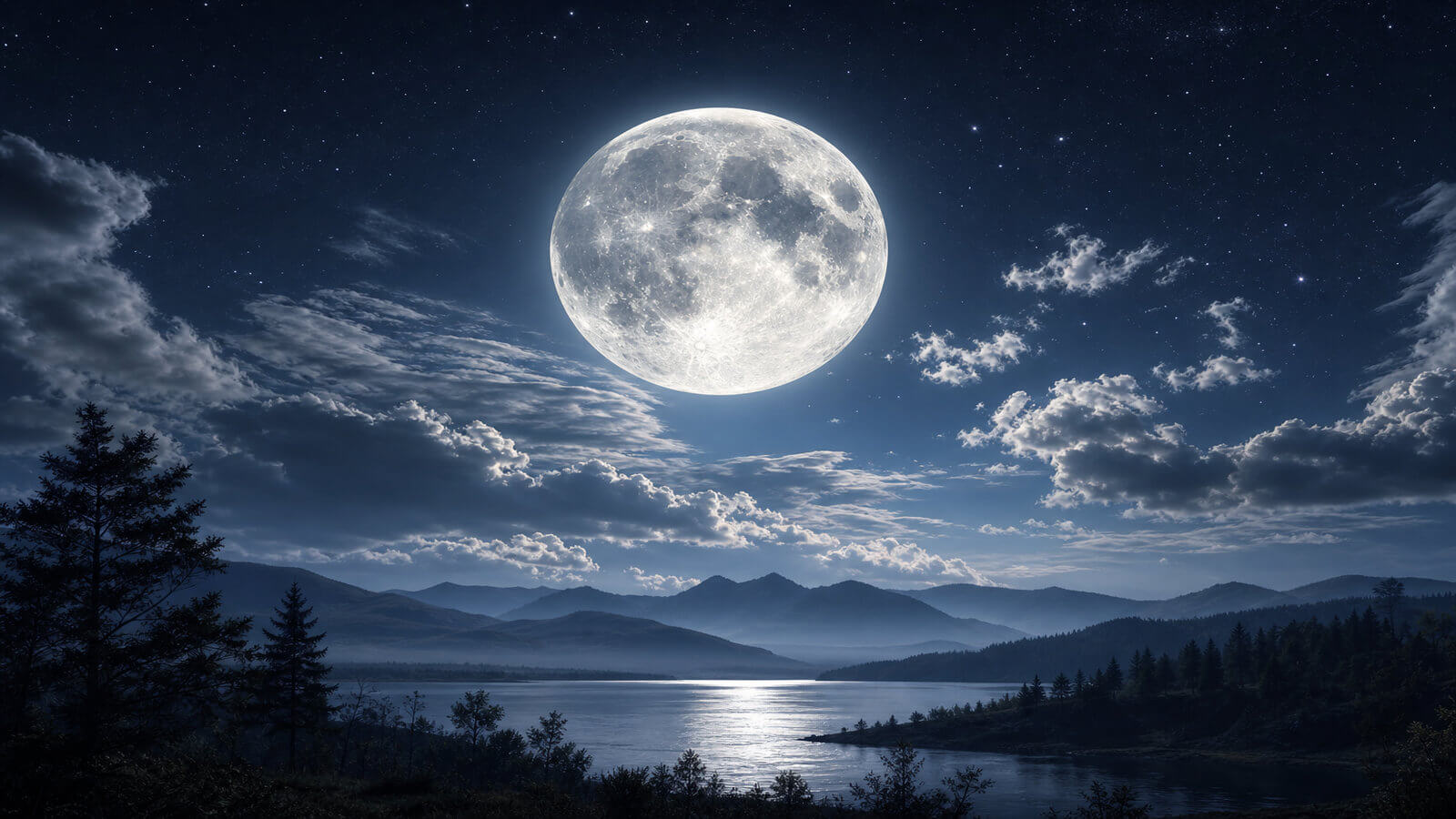
Full Moon Meaning in Astrology
The full moon is the peak of the lunar cycle: maximum light, maximum visibility. In the chart of the sky, the Sun and Moon stand in opposition, pulling awareness toward what was seeded at the new moon two weeks earlier. What has been building in the dark now becomes visible.
Emotions often run higher near a full moon. Dreams may be more vivid. Conversations that were avoided can no longer wait. The full moon illuminates truth, sometimes beautifully, sometimes uncomfortably. Many people feel a natural surge of energy, restlessness, or emotional clarity in the days surrounding it. Read each full moon against your birth chart to see which house it crosses.
Common Themes
Culmination. Projects reach a visible stage; results show whether earlier effort is working. Outcomes tied to the new moon two weeks prior often become clear.
Relationship clarity. The Sun-Moon opposition highlights self versus other. Questions of balance, projection, and honest connection tend to surface naturally.
Release. What has been completed, outgrown, or held too tightly can be honored and let go, making room for the next cycle to begin cleanly.
Supermoons and eclipses. When the full moon coincides with the Moon near perigee (its closest orbital point), the effect tends to feel amplified. Lunar eclipses, which only happen on full moons, can accelerate endings, revelations, and emotional turning points. Read our eclipse season guide for annual timing.
Full Moon by Sign
Each full moon falls in a specific zodiac sign, coloring its themes. The sign the Moon occupies, and the sign the Sun is in at the same time, together describe the polarity of the sky's invitation that month.
Explore each sign in depth:
- Full Moon in Aries
- Full Moon in Taurus
- Full Moon in Gemini
- Full Moon in Cancer
- Full Moon in Leo
- Full Moon in Virgo
- Full Moon in Libra
- Full Moon in Scorpio
- Full Moon in Sagittarius
- Full Moon in Capricorn
- Full Moon in Aquarius
- Full Moon in Pisces
To feel the full moon personally, notice which house in your natal chart the Moon falls in. A full moon crossing your 10th house may bring career matters to a head; in your 4th house, family or home themes peak; in your 7th, partnerships come into focus. The opposite house, where the Sun sits, shows what you are balancing against that peak.
Check the current sign through our zodiac seasons hub for collective mood. A full moon in a sign that also hosts strong transits from Jupiter or Saturn can feel like a public checkpoint, not only a private emotional surge.
Working With Full Moons
The full moon window is roughly three days: the day before, the day of, and the day after exact opposition. Practices that work well during this time:
- Gratitude and acknowledgment. Recognize what has grown or been accomplished since the last new moon.
- Release work. Write down what you are ready to let go of, habits, resentments, identities, and burn or bury the paper as a symbolic close.
- Honest conversation. The full moon supports clarity in dialogue. Speak what has been unsaid, calmly and directly.
- Rest after the peak. The day after a full moon often calls for integration and quiet rather than new action.
Avoid impulsive ultimatums if emotions are running very high. Full moon clarity is best used for honest awareness, not reactive decisions. Allow a day or two for the initial emotional intensity to settle before taking major action.
Relationship full moons often expose projection: what you react to strongly in another person may mirror something you have not owned in yourself. That insight is useful when handled calmly. The full moon does not require confrontation; it requires visibility. Sometimes naming the truth privately is enough for the cycle to shift.
Full moon work does not require ceremony. A written list of what is complete, one honest conversation, and a good night's sleep can be enough. The astrology points to visibility; your job is to look clearly, not to perform drama.
Full Moon at a Glance
| Topic | Guidance |
|---|---|
| Window | Day before, day of, and day after exact opposition |
| Best for | Gratitude, release work, honest conversation, integration |
| Avoid | Impulsive ultimatums while emotions are at peak intensity |
| Pairs with | Intentions set at the prior new moon |
| Eclipse full moons | Accelerated endings; see eclipse season |
Monthly Full Moons
Full moons repeat approximately every 29.5 days, about once per calendar month. Occasionally two full moons fall in the same calendar month; the second is colloquially called a Blue Moon. Each full moon is named by the sign it occupies, not only by folk calendar names (though traditional names like Harvest Moon and Hunter's Moon remain widely used).
2026 full moon calendar by sign
2026 has thirteen full moons, including a Blue Moon in Sagittarius (May 31) and two full moons in Cancer (January 3 and December 24). Lunar eclipses occur March 3 (Virgo) and August 28 (Pisces). Times vary by time zone; confirm locally if you are planning ritual work on the exact minute.
| Date (2026) | Moon sign | Traditional name |
|---|---|---|
| January 3, 2026 | Cancer | Wolf Moon |
| February 1, 2026 | Leo | Snow Moon |
| March 3, 2026 | Virgo | Worm Moon (Lunar eclipse) |
| April 2, 2026 | Libra | Pink Moon |
| May 1, 2026 | Scorpio | Flower Moon |
| May 31, 2026 | Sagittarius | Blue Moon (Second full moon in May) |
| June 29, 2026 | Capricorn | Strawberry Moon |
| July 29, 2026 | Aquarius | Buck Moon |
| August 28, 2026 | Pisces | Sturgeon Moon (Lunar eclipse) |
| September 26, 2026 | Aries | Harvest Moon |
| October 26, 2026 | Taurus | Hunter's Moon |
| November 24, 2026 | Gemini | Beaver Moon (Supermoon) |
| December 24, 2026 | Cancer | Cold Moon (Supermoon) |
Track the wider lunar cycle in our moon phases guide and explore the full cycle of eight phases. Pair monthly full moons with your horoscope for pacing, and notice whether the activated house matches themes you set at the prior new moon. That two-week arc is the simplest way to test whether lunar timing is useful in your own life.
Full moons in fixed signs (Taurus, Leo, Scorpio, Aquarius) often highlight stubborn patterns ready for honest review. Full moons in cardinal signs (Aries, Cancer, Libra, Capricorn) can push decisions to a head. Mutable full moons (Gemini, Virgo, Sagittarius, Pisces) tend to spread attention across several threads at once. The element adds texture, but the house in your chart still tells you where the story lands personally.
If sleep or mood shifts near every full moon, note the house activated and any natal Moon aspects triggered. Patterns repeat. What feels mysterious at first often becomes a reliable monthly checkpoint once you connect sky timing to your own chart.
More moon phase guides
Our approach
How we write astrology guides
Astrologylo uses the Western tropical zodiac and standard natal chart conventions unless a page states otherwise. Guides combine traditional symbolism with plain-language interpretation for self-reflection. For calculated placements such as moon, rising, or exact house cusps, use our birth chart calculator. Pair planet meanings with compatibility reports when comparing relationship patterns.
See the full editorial methodology for scoring standards, update practices, and entertainment disclaimer.