Planets
Planets in Astrology
The Sun, Moon, and planets in Western astrology: what each one means in your birth chart and how to read sign, house, and aspect placements.
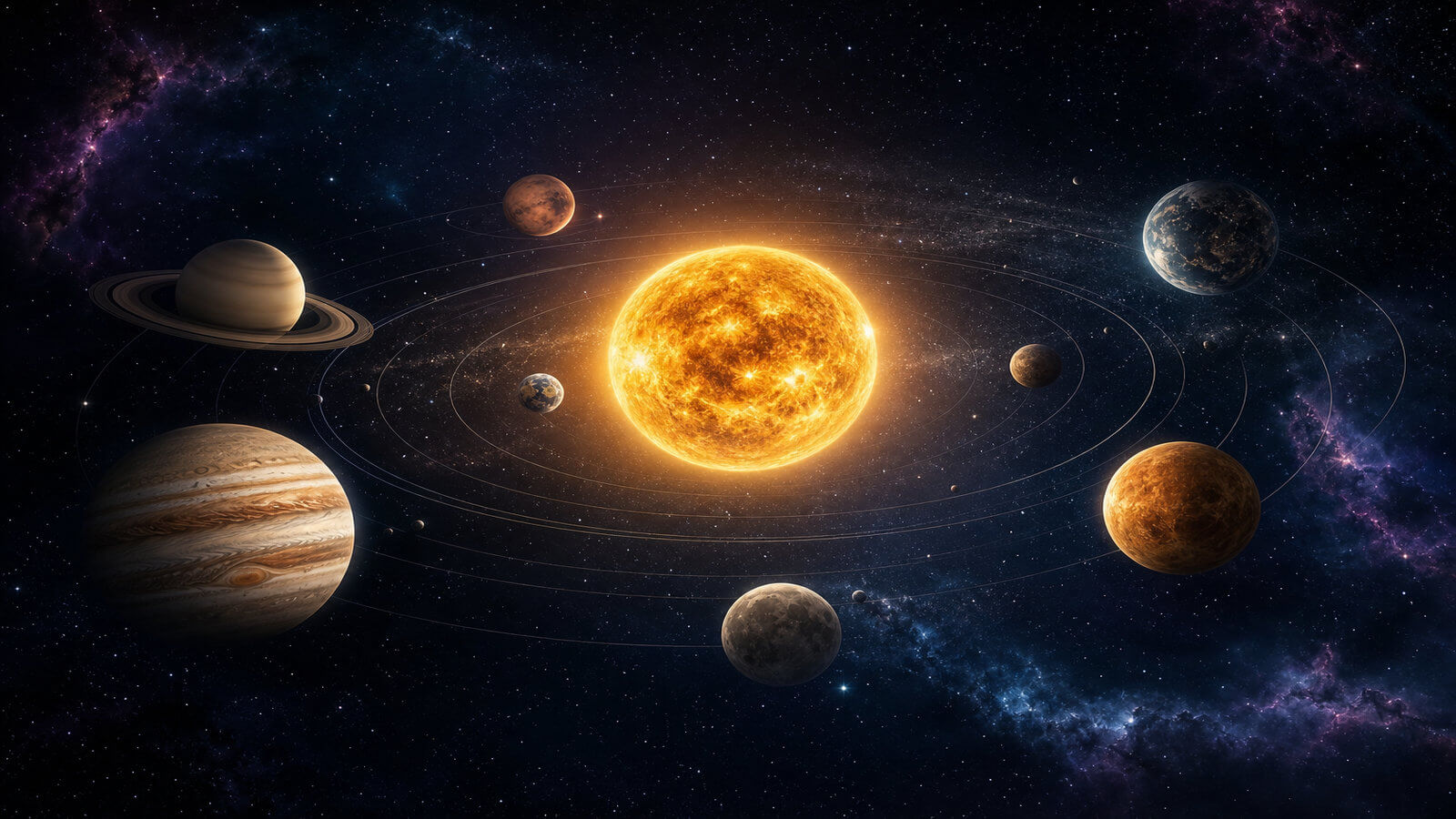
Planets in Western Astrology
In Western astrology, the planets are the active forces of the chart. Zodiac signs describe how energy expresses itself; houses show where life themes unfold; aspects reveal how planetary voices cooperate or challenge each other. Together they form the language of the birth chart.
Modern tropical astrology typically uses ten bodies: the Sun, Moon, Mercury, Venus, Mars, Jupiter, Saturn, Uranus, Neptune, and Pluto. The Sun and Moon are often called luminaries. Mercury, Venus, and Mars are personal planets. Jupiter and Saturn are social planets. Uranus, Neptune, and Pluto are outer planets: slow-moving, generational, and transformational.
Each planet answers a different question. The Sun asks who you are becoming. The Moon asks what you need to feel safe. Mercury asks how you think and speak. Venus asks what you value and attract. Mars asks what you want enough to fight for. Jupiter asks where you grow and take faith. Saturn asks where life demands maturity. The outer planets ask how your generation reshapes freedom, dreams, and power.
Personal Planets: Sun, Moon, Mercury, Venus, and Mars
Personal planets move quickly enough that two people born weeks apart can have different Mercury, Venus, or Mars signs. That is why Sun sign horoscopes feel partly accurate and partly incomplete: they describe one voice in a choir.
The Sun is identity, vitality, and purpose. It shows the life direction you are growing toward and the confidence you bring to visible choices. The Moon is emotion, memory, and belonging. It describes what soothes you, how you nurture others, and the private rhythm beneath public presentation.
Mercury governs mind, message, and logistics: learning, writing, negotiation, and the daily traffic of information. Venus governs love, beauty, pleasure, and values: what you find attractive, how you relate, and what you are willing to invest in. Mars governs drive, desire, and action: how you pursue goals, assert boundaries, and handle conflict.
When beginners ask where to start, personal planets are the answer. They describe temperament, communication style, relationship patterns, and motivation in language you can recognize in everyday life. Read each in depth: the Sun, the Moon, Mercury, Venus, and Mars.
Social Planets: Jupiter and Saturn
Jupiter and Saturn sit between the personal and outer worlds. They move slowly enough to stay in a sign for about a year (Jupiter) or two and a half years (Saturn), so many peers share the same placement. Yet they still shape individual charts through house position and aspects to faster planets.
Jupiter expands whatever it touches: faith, opportunity, travel, education, and the willingness to take a calculated risk. It can bless and exaggerate in equal measure. A strong Jupiter placement may describe natural optimism, teaching ability, or success through breadth. A challenged Jupiter may describe overpromising, restlessness, or growth that arrives only after learning limits.
Saturn contracts, structures, and tests. It describes discipline, responsibility, fear, mastery, and the rewards of patience. Saturn transits often coincide with reality checks that are uncomfortable in the moment and stabilizing in hindsight. In the natal chart, Saturn shows where you must earn confidence rather than assume it.
Together Jupiter and Saturn map the social layer of the chart: how you participate in institutions, career paths, mentorship, and the long arc of adult development. Explore Jupiter in astrology and Saturn in astrology for sign, house, and transit themes.
Outer Planets: Uranus, Neptune, and Pluto
Uranus, Neptune, and Pluto move so slowly that entire age cohorts share the same sign. They describe collective moods, cultural shifts, and deep personal transformation when they aspect natal planets by transit.
Uranus is innovation, disruption, and the hunger for freedom. It breaks stale patterns, sometimes through sudden change, sometimes through gradual rebellion against what no longer fits. Neptune is dreams, spirituality, imagination, compassion, and illusion. It dissolves boundaries and asks for discernment between inspiration and escape. In 2026, Neptune continues its historic shift into Aries after more than a decade in Pisces, reshaping collective ideals toward new spiritual courage. Read Neptune in astrology for the full picture.
Pluto is transformation, power, and what must die so something truer can live. Pluto transits rarely feel casual. They expose control dynamics, buried desire, and the places where authenticity costs something real. Outer planet work is generational and personal at once: the world changes, and your chart shows where that change lands in your private life.
Dive deeper: Uranus, Neptune, and Pluto.
Mercury, Venus, and Mars: The Inner Planet Cluster
Mercury, Venus, and Mars form a practical cluster for reading relationship and action patterns in the chart. They never stray far from the Sun in the sky, so their sign combinations often describe a coherent style: how you think, what you want, and how you go after it.
Mercury-Venus contacts favor charm, aesthetic intelligence, and diplomacy in speech. Mercury-Mars contacts sharpen debate, quick decisions, and direct language. Venus-Mars contacts blend attraction with pursuit: chemistry, creative passion, and the tension between harmony and conquest. Aspects between these three planets explain why two people with the same Sun sign can feel entirely different in conversation, romance, and conflict.
If you are building chart literacy, read this cluster as one unit after Sun and Moon. Our dedicated guides cover Mercury, Venus, and Mars in sign, house, dignity, and transit. Pair them with natal chart basics for houses and aspects.
The Connection between Astrology and the Planets
We are connected to the universe: living on a rotating globe beneath a moving sky. In astrology, planetary symbolism describes how cosmic patterns mirror inner experience. Thoughts become actions. Habits shape fate. Timing matters. The Sun, Moon, and planets each carry a distinct voice in the chart.
At birth, the position of every planet in the twelve houses is decisive. The Sun and Jupiter often describe visibility and growth. The Moon and Venus speak to feeling and relating. Mercury handles logistics and language. Mars supplies drive. Saturn teaches patience and limits. Uranus, Neptune, and Pluto add layers of innovation, imagination, and deep change across generations.
Explore each body in depth: the Sun, the Moon, Mercury, Venus, Mars, Jupiter, Saturn, Uranus, Neptune, and Pluto.
Understanding the Planets and Their Meanings
What do the planets in astrology mean? In Western practice we treat the Sun and Moon as chart rulers alongside Mercury through Pluto. Earth is the observer's standpoint. The chart is a geocentric map of the sky at a specific moment, not a literal claim about the solar system's center.
Each planet describes a life theme. The Sun is identity and purpose. The Moon is emotion and belonging. Mercury is mind and message. Venus is love and values. Mars is desire and action. Jupiter is faith and expansion. Saturn is structure and maturity. Uranus is freedom and breakthrough. Neptune is dreams and compassion. Pluto is transformation and power. Sign placement colors the style. House placement shows the arena. Aspects describe relationships between these forces.
Rulership and dignity add nuance. Mars rules Aries and traditionally co-rules Scorpio. Venus rules Taurus and Libra. Mercury rules Gemini and Virgo. A planet in the sign it rules often expresses its themes clearly. A planet in detriment or fall is not doomed. It describes a learning curve: the same gift asked to work in an unfamiliar style.
How to Read Planets in Your Chart
Start with sign placement (style), then house (life area), then aspects (relationships between planets). A planet in the 10th house speaks to career and public reputation regardless of sign. A planet in the 7th house emphasizes partnership themes. Sign tells you how the planet behaves. House tells you where you notice it most.
Next, read aspects. Conjunctions blend two voices. Trines and sextiles describe cooperation. Squares and oppositions describe friction that produces growth when handled consciously. A Mars square Saturn chart is not cursed. It may describe someone who builds strength through sustained effort rather than instant wins.
Retrograde planets in the natal chart often internalize that planet's themes. In transit, retrograde cycles favor review, as with Mercury retrograde. Finally, zoom out. One difficult placement does not erase a chart full of resource. Context always comes from the whole pattern.
Ready to see your own placements? Use our birth chart calculator to generate your map, then return to the planet guides below for interpretation. For collective timing, pair planetary themes with zodiac seasons and moon phases.
Planetary Transits: The Moving Sky
Your natal chart is a snapshot. Transits are the moving sky interacting with that snapshot. When today's Jupiter crosses the degree of your natal Venus, Jupiter-Venus themes activate: expansion in love, money, or creativity. When Saturn crosses your Sun, life may ask for seriousness, restructuring, or delayed gratification in identity and career.
Transits work on layers. Fast planets like the Moon change mood hour to hour. Mercury, Venus, and Mars shape weeks and months. Jupiter and Saturn mark chapters that last a year or more. Uranus, Neptune, and Pluto describe multi-year transformations that often feel fated because they unfold too slowly to rush.
You do not need to track every transit to benefit from astrology. Start with the Sun and Moon for daily and monthly rhythm. Add Mercury retrograde for communication review. Notice when outer planets aspect your angles or luminaries: those periods often coincide with the most memorable turning points. The guides linked on this page each include transit sections for their planet.
Astrology Aspects: Current, Transitory and Natal
As planets move around the zodiac, their relationship to Earth changes day to day. There are times when the effect they have on Earth is harmonious because of the position of another planet as it moves about its path. The real-time interaction of two planets is called a current aspect. It is happening in the sky right now.
Harmonious planetary aspects between two moving planets can lead to pleasant stretches of time. Tense aspects can coincide with friction or urgency. The second type is a transitory aspect: a planet moves into relationship with a degree that was occupied at your birth. The location of the planets at the moment of your birth is recorded as your astrology chart. The imprint of those positions is your lifelong baseline for how you meet the world.
The aspects between planets in your birth chart are your natal aspects. As planets continue moving, they interact with those natal degrees. When tension among the planets is adversely affecting the collective mood, the sky may still be interacting harmoniously with your personal chart. The reverse is also true. Ever felt great when everyone else was miserable? That is transitory aspects meeting your natal pattern differently than the weather of the day.
Harmonious Aspects: Conjunctions, Trines and Sextiles
There are three major harmonious aspects in astrology between planets: the conjunction, the trine, and the sextile. When a planet moves into the same part of the zodiac as another planet, this is a conjunction. While these bodies are vast distances apart in space, they appear together from Earth's view and thus combine their themes. A solar eclipse is a dramatic example: the Sun and Moon share the same sky.
A sextile forms when two points are 60° apart, typically two signs away. Many people notice an uplift when the transiting Sun makes a sextile to their natal Sun, roughly sixty days before and after each birthday. A trine is a 120° relationship between signs of the same element: Fire, Earth, Air, or Water. Trines often describe natural talent and ease. In the natal chart they can mark personality strengths that flow without much effort.
Hard aspects (squares and oppositions) are not "bad," but they ask for effort and awareness. For a full aspect vocabulary, see our blog guide on aspects of astrology, or calculate your own pattern with the birth chart tool.
Your Birth Chart: Next Steps
The planets are the verbs of astrology. Signs are adverbs. Houses are the settings. Aspects are the dialogue. No single placement tells the whole story, but every placement adds a sentence.
Start with our free birth chart calculator. Note your Sun, Moon, and rising first. Then read the personal planets, social planets, and any outer planet closely aspecting an angle or luminary. Return to this hub whenever you want the big picture.
Your chart is a conversation, not a verdict. Use it to name patterns, test timing, and choose with more awareness. The ten guides below are your reference library for every planetary voice in the map.
All planet guides: Sun · Moon · Mercury · Venus · Mars · Jupiter · Saturn · Uranus · Neptune · Pluto